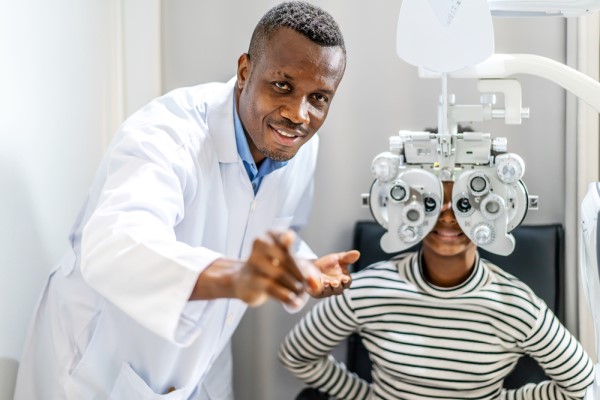
Regular eye examinations from an eye doctor are simple, fast, and comfortable for the most part. These screenings are advisable to keep your vision prescription updated, know if a prescription is necessary, and ensure your eyes are in good condition. Regular eye checkups are the first step towards preventing eye ailments such as chronic dry eye, inflammation, glaucoma, age-related problems, and cataracts.
As a first-time patient or someone who has not had a full eye exam in a while, you may be unclear of what to anticipate. The eye doctor will determine your eye health using a variety of tests and treatments. The process might be as basic as using an eye chart to determine your visual acuity or as sophisticated as using a biomicroscope to study the components of your eye at extreme magnification.
What happens during a vision test from an eye doctor?
Visual acuity tests are often one of the initial processes during an eye exam. A projected eye chart is frequently used, with the letters shrinking in size with each line progression. This step tests the acuity of distance vision. Also, the doctor will use a handheld acuity chart to assess near vision.
Pupil reaction
During this part of the vision screening, the eye doctor will observe how the patient's pupils react when light or other objects come close to the eyes. Also, the doctor will check the whites of the eyes and the position of the eyelids.
The cover tests
Optometrists often use the cover test to determine the complementary function of the two eyes. Patients will direct their attention to a tiny item positioned away during a cover test. The doctor will check each eye's movement while the other is covered.
Color blindness test
This test involves Ishihara Plates, which consist of colored circles showing a number. The number is only visible to someone that is not color blind.
Stereopsis
For a stereopsis test, 3D glasses are typically utilized to measure depth acuity. Patients will be asked to look at a booklet containing patterns, each with four little circles, and pick out which circle in each design seems the closest.
The alignment test
For this test, the patient will need to stabilize their head and concentrate on a tiny item, such as a pen. With their eyes locked on the item, the doctor will move it slowly. Studying the eyes as they move helps the doctor determine the eyes' alignment.
The refraction test
A prescription for eyeglasses demands taking a refractor test. The exam requires a phoropter machine, which has a variety of lenses. The eye doctor will swap between the lenses and ask whether the lens improves or worsens the patient's vision.
Pupil dilation measurement
A dilated eye exam may reveal the risk of developing common eye disorders that are often asymptomatic. An optometrist may do a more complete examination of the eyes with dilating eye drops. The pupils enlarge due to the drops, enabling better light reception. The eye doctor will use special lenses to examine the interior of your eyes once eye drops or other methods have sufficiently dilated them. Modern retinal imaging systems also enable eye physicians to take a high-resolution, wide-angle snapshot of a patient's retina without the need for dilating drops.
The slit lamp exam
A slit lamp is designed to inspect the eye's internal anatomy at very high magnification. The doctor will begin with the front part of the eyes, including the eyelids, cornea, iris, lens, and conjunctiva. The optic nerve and retina, as well as other tissues in your eye, may also be examined by your optometrist. The slit lamp test can work as a diagnostic tool for various eye diseases like diabetic retinopathy and cataracts.
Non-contact tonometry
It is called non-contact tonometry (NCT), but many still call it the "puff-of-air" test. For this test, the patient will put their chin on the NCT machine's chin rest and stare at the light within it. The machine will deliver a focused burst of air into the eye to determine intraocular pressure, and if the pressure is too high, this may indicate a risk of getting glaucoma.
The visual field examination
A visual field test examines peripheral vision to see any blind spots. Some eye conditions, such as glaucoma, may cause blind spots.
The bottom line
Vision tests from an eye doctor are necessary for good eye and overall health, besides helping you maintain a clear vision. In addition to helping diagnose illnesses that might otherwise go undetected without a physical examination, these tests may illuminate other health issues, such as diabetes.
Get more information here: https://www.texasoptical.net or call Texas Optical at (214) 771-7333
Check out what others are saying about our services on Yelp: Read our Yelp reviews.
Recent Posts
Protecting vision in hazardous environments requires the use of specialized safety glasses to prevent injuries from flying debris, chemicals, or intense light. We offer a range of protective eyewear to ensure patients in Dallas maintain clear, safe vision across various environments. Whether working on a construction site or engaging in home improvement projects, selecting the…
Progressive lenses make it possible to see clearly at multiple distances without switching between pairs of glasses throughout the day. These lenses combine distance, intermediate, and near vision correction into one smooth design. An optometrist may recommend them when a patient needs glasses for reading, computer work, and driving all at the same time. Learning…
Seeking professional red eye treatment addresses the root cause of ocular irritation rather than merely masking symptoms with temporary, over-the-counter (OTC) solutions. While many people view a bloodshot appearance as a minor nuisance, redness in the eyes is often a primary signal of underlying health concerns. These issues range from simple environmental allergies to more…
Maintaining healthy eyes is an essential part of overall wellness. Therefore, scheduling regular optometry visits is an important step toward preserving clear, comfortable vision. These appointments do far more than determine whether a person needs glasses or contact lenses. They help assess both visual performance and the health of the internal and external eye structures.…