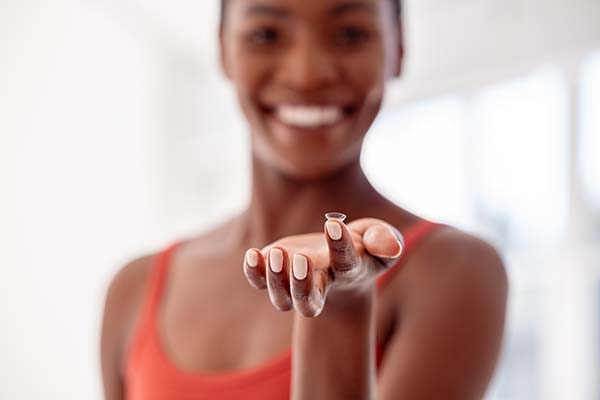
Contact lenses are clear lenses that fit over the eye, making them a discreet alternative to prescription glasses. Contacts can correct a variety of vision problems. This article will explore this method of vision correction, discussing when contact lenses are a good fit, what to expect during a contact lens examination, and why these exams are important.
About contact lenses
Contact lenses, also known as simply “contacts,” fit over the eye's cornea. The iris and pupil constitute the cornea. It is important to have an optometrist fit one’s contact lenses, as they must fit directly over the cornea and not extend to the white of the eye. An optometrist may utilize contacts to correct the following vision problems:
- Hyperopia: Also known as “farsightedness,” hyperopia is when one has difficulty seeing close objects clearly but has no trouble seeing objects far away.
- Myopia: Also known as “nearsightedness,” myopia is when one can see close objects clearly but has trouble seeing objects in the distance.
- Astigmatism: When the cornea or lens is more curved than usual, it creates a refractive error and leads to blurred vision. With astigmatism, objects will appear only partly in focus; at night, lights will have an unnatural glare or halo effect.
When contact lenses are not recommended
An optometrist can evaluate one's candidacy for contact lenses during an examination. Some common factors may make contacts a poor choice for vision correction. Typically, contacts are not ideal for patients who:
- Have severe allergies
- Have low tear production (insufficient eye lubrication)
- Repeatedly get eye infections
- Are younger than nine years of age
- Are regularly exposed to fumes, smoke, or dust
Contact lens exams
In order to get contact lenses, patients must visit an optometrist for a contact lens exam. A vision test is an important component of this exam, as the optometrist will use an eye chart and various lenses to create a custom prescription. They will also assess one's overall eye health.
Up to this point, the exam will be similar to a regular eye exam. If the patient seems like a good candidate, the optometrist will then fit them for contact lenses. This involves taking measurements of the eye's surface (specifically, the cornea) to determine which type and size of contact would be best. Another test, known as a "tear film evaluation," can ensure enough natural eye lubrication to support contacts. The optometrist will then recommend various contact lenses (soft lenses, disposable contacts, extended-wear contacts, etc.) to find one that best fits the patient's needs.
What else to expect
The optometrist will prescribe about a week's worth of trial contact lenses and schedule a follow-up evaluation. This allows the patient to ask for a different type of contact if necessary. Alternatively, they can have adjustments made to their prescription or the fit of their current contacts.
Patients can also expect annual eye exams after receiving contacts. These help the optometrist track one's eye health, order new contacts, and ensure this method of vision correction continues to work as intended.
Why contact lens exams are important
Contact lens exams are crucial for several reasons, the first being that vision changes over time and one’s prescription will likely need to be updated over the years. Contacts can also impact the long-term health of the eye because the cornea cannot absorb as much oxygen when covered by a contact lens. This can lead to eye irritation and dryness, which an optometrist may remedy with a different type of contact. In some cases, switching to glasses is the best option.
Routine contact lens exams also allow the optometrist to ensure that the contacts continue to fit properly. If contacts become misshapen or damaged, the optometrist will order replacements to protect the health of the eye. Allowing the patient to wear ill-fitting contacts (whether too big or shrunken) can lead to a host of issues.
Disadvantages of ill-fitting contact lenses
Wearing ill-fitting contacts puts one at risk of eye injury, infection, and disease. For example, if the contacts scratch the cornea (corneal abrasion), the patient may experience eye pain and redness, light sensitivity, and headaches. Corneal abrasion may become infected and negatively impact vision.
Ill-fitting contact lenses could also result in corneal ulcers, eye infections, and vision loss, such as from tight lens syndrome (a result of shrunken contact lenses that stick to the eye). Additionally, it is possible for patients to develop a contact lens intolerance due to poorly fitting contacts. The good news is these issues may be avoided, prevented, and, if needed, treated quickly through annual contact lens examinations.
Book your next contact lens exam
If you are considering getting contacts or if you wear contacts and have not been to the optometrist in over a year, consult our optometrist. We can help update your prescription, order new contacts, or ensure that your current contacts are in working order. Call our office today.
Request an appointment here: https://www.texasoptical.net or call Texas Optical at (214) 771-7333 for an appointment in our Dallas office.
Check out what others are saying about our services on Yelp: Contact Lenses in Dallas, TX.
Recent Posts
Protecting vision in hazardous environments requires the use of specialized safety glasses to prevent injuries from flying debris, chemicals, or intense light. We offer a range of protective eyewear to ensure patients in Dallas maintain clear, safe vision across various environments. Whether working on a construction site or engaging in home improvement projects, selecting the…
Progressive lenses make it possible to see clearly at multiple distances without switching between pairs of glasses throughout the day. These lenses combine distance, intermediate, and near vision correction into one smooth design. An optometrist may recommend them when a patient needs glasses for reading, computer work, and driving all at the same time. Learning…
Seeking professional red eye treatment addresses the root cause of ocular irritation rather than merely masking symptoms with temporary, over-the-counter (OTC) solutions. While many people view a bloodshot appearance as a minor nuisance, redness in the eyes is often a primary signal of underlying health concerns. These issues range from simple environmental allergies to more…
Maintaining healthy eyes is an essential part of overall wellness. Therefore, scheduling regular optometry visits is an important step toward preserving clear, comfortable vision. These appointments do far more than determine whether a person needs glasses or contact lenses. They help assess both visual performance and the health of the internal and external eye structures.…