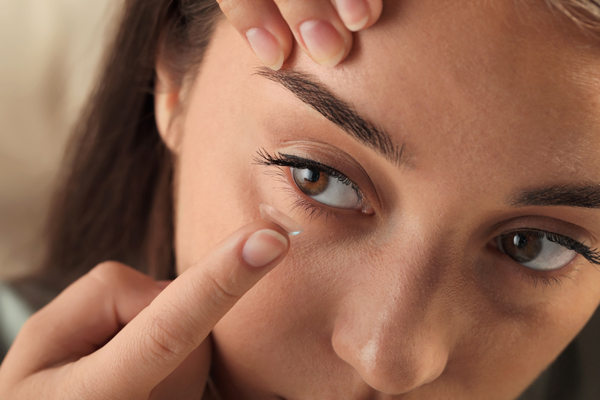
When people hear they need a prescription lens to see more clearly, most automatically think of having to wear glasses. Fortunately, contact lenses can provide the prescription patients need while being discreet. Prescription contact lenses are thin, curved lenses in the shape of small disks that rest on the tear film of a person's eyes.
Prescription contacts are a common form of eyewear that will not be noticeable when the patient wears them. Contact lenses are one of the preferred vision aids for people who would rather not have to wear glasses daily. If you are interested in prescription contacts, call us and schedule an appointment today.
Benefits of wearing prescription contacts
While some people may prefer traditional prescription glasses, others enjoy the discreet appearance of contact lenses. The reasons people may choose contacts instead of eyewear include:
- The convenience of being able to wear certain contact lenses for months at a time
- No need to constantly clean contacts like having to clean glasses
- Being able to avoid the appearance of wearing glasses
- Contacts do not become cloudy or fall off the wearer's face as eyeglasses can
Unlike generic contact lenses, prescription contact lenses are specifically designed with the patient's eyes in mind.
What are prescription contacts?
Contact lenses are typically thin, clear, and transparent. While there are several different types of contact lenses to choose from, a common choice is gas permeable lenses. The durable plastic in this type of lens transmits oxygen to the eye. In some cases, patients can wear these lenses overnight.
Soft lenses are another popular option for most people, given the huge difference in comfort and how long people can wear them. The choice that the patient ends up wearing will depend on various factors such as the prescription they need and their preference.
How prescription contacts work
Prescription contacts work similarly to eyeglasses. They serve as lenses that focus images in the right place on the retina. The retina processes the light that comes into the eyes while the natural lens on each eye and the cornea focus light on the retina. The retina then sends the information to the brain.
When a person has nearsightedness, the light that comes into the eye is sent too far in front of the retina. When the person has farsightedness, the light is sent too far back into the retina. Other issues like astigmatism can also affect how light focuses on the retina.
The different types of prescription contact lenses
With various types of contact lenses, it is important to understand how they work. We can go over these in greater detail with the patient during a consultation.
1. Soft
Soft contact lenses typically consist of flexible, soft plastics that let oxygen get through to the cornea. They are more comfortable than hard lenses and are easier to adjust to.
2. Rigid gas permeable
Rigid gas permeable lenses are more resistant to the buildup of deposits and more durable. They can also provide sharper, crisper vision. They usually last longer than soft lenses and are easier to handle. However, it can take longer to adjust to them.
3. Extended wear
Extended wear contact lenses are a type of soft lens that patients can wear overnight or continuously for up to a month.
4. Disposable
Disposable lenses are discarded after each use. They are used for a day and replaced with another set the next day. In many cases, people will need to make regular orders for these lenses.
Frequently asked questions about prescription contacts
Thinking about getting contacts? Let us take a look at some commonly asked questions:
1. What are prescription contacts?
Prescription contacts, also called corrective lenses, are visual aids that are worn in front of the eyes to improve vision. They are made to correct refractive errors, such as myopia (nearsightedness), hyperopia (farsightedness), and astigmatism.
2. How do prescription contacts work?
Prescription contacts work by bending the light that enters the eye to allow the light to focus directly on the retina, resulting in clearer vision.
3. Who can wear prescription contacts?
Almost anyone can wear prescription contacts, including children and adults. However, some people should not wear them, such as those with current eye disorders or diseases. It is crucial to consult with an eye care professional before wearing prescription contacts.
4. What are the benefits of wearing prescription contacts?
There are many benefits to wearing prescription contacts, including improved vision, increased self-confidence, and a more active lifestyle. Additionally, prescription contacts are more comfortable to wear than glasses and do not fog up or get in the way during activities.
5. Are there any risks associated with wearing prescription contacts?
Yes, there are some risks associated with wearing prescription contacts. These include the risk of developing an eye infection or other serious eye condition. It is essential to follow all instructions provided by your eye care professional to reduce the risk of developing these complications.
6. How should I care for my prescription contacts?
It is vital to follow all instructions provided by your eye care professional when caring for your prescription contacts. This includes cleaning and storing them properly. Additionally, you should schedule regular eye exams to ensure that your prescription contacts are still working correctly.
We are here to help
Ready for prescription contacts? Give us a call or stop by our Dallas clinic to schedule an appointment.
Request an appointment here: https://www.texasoptical.net or call Texas Optical at (214) 771-7333 for an appointment in our Dallas office.
Check out what others are saying about our services on Yelp: Read our Yelp reviews.
Recent Posts
A contact lens exam addresses different questions than a standard eye exam. It evaluates the cornea, lids, and tear film, then matches lens materials and designs to vision needs and eye health. Lenses sit directly on the eye, so small details such as curvature, diameter, and oxygen flow influence comfort, clarity, and safety. An optometrist…
Standard vision tests, or eye exams, help ensure accurate prescriptions for glasses and support long-term eye health for people who wear corrective lenses. Even small prescription changes can affect headaches, screen comfort, and night driving clarity. Eye exams also screen for conditions that may not present with early symptoms, making routine testing an important habit.…
Pediatric eye care is the key to clear vision and confident learning that starts in childhood. Unfortunately, even minor vision problems can negatively affect reading, coordination, and classroom focus. Many parents come to realize how common it is for children to pass quick screenings yet struggle with focusing, eye strain, or fatigue during schoolwork. A…
The selection of eyewear feels significantly easier when the styles and craftsmanship of Versace eyewear enters the conversation, since bold lines and iconic detailing create an instantly recognizable look. Versace represents the intersection of Italian fashion and Greek mythos, blending confident glamour with symbolism through its signature Medusa logo. The brand is widely associated with…