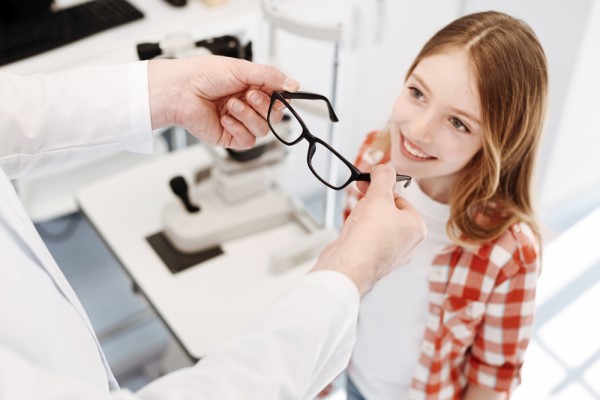
Pediatric eye care services help diagnose and address issues that might affect your child’s vision. How well a child can see impacts their learning ability, since about 80% of the learning process is visual. Children mostly learn about the world around them by observing their surroundings.
Pediatric eye care helps ensure that visual problems are not hindering your child. Eye exams should be performed as the child reaches different stages in their development. The American Optometric Association recommends taking your child in for their first eye examination by the time that they are six months old, when they reach the three-year mark, when they start school, and every two years throughout the rest of their childhood.
A child might need to get their vision evaluated more frequently if they have risk factors like a family history of eye defects, being born prematurely, or issues like a lazy eye. Children who need to have their vision corrected should see an optometrist at least once a year. Children's eyes grow rapidly, so their prescription might no longer adequately correct their vision after a year.
Essential pediatric eye care services that your child needs
Let us take a close look at the different eye care services that an optometrist might recommend for a child.
Infant eye exam (infants younger than 24 months)
A baby's eyes develop gradually for the first few months of their life. They must learn how to move their eyes and use them together to form clear pictures. The child’s brain also needs to learn how to process all the visual information. The development of a child’s eyesight serves as the foundation for hand-eye coordination and motor development skills, like crawling and walking.
A child’s first eye examination should occur when they are about six months old. During this examination, the optometrist will evaluate the child’s vision to ensure that they can see correctly and will detect any conditions that could negatively affect their vision or eye health. The optometrist might recommend follow-up examinations if the child has risk factors for developing eye problems.
Preschool eye examination
This exam typically takes place around ages two to five. It is performed to diagnose and treat any developing eye problems that are hindering a child’s vision and limiting the development of their motor skills and learning abilities.
The optometrist looks for issues like crossed eyes and lazy eyes at this stage. These disorders are generally easier to treat when a child is young.
Signs that a child might have vision issues at this stage include sitting close to the TV or reading material, frequently rubbing their eyes, avoiding activities like coloring books, or squinting frequently. Addressing these issues early sets up the child for success as they start academics.
School-age eye examination
These exams are performed on children from the ages of six to 18. Children with undetected vision issues often suffer academically, athletically, personally, and socially. A child's struggle with their academic course load or extracurricular activities might signify a vision problem. These exams help diagnose any existing issues, so they do not impact the child’s academic and athletic development.
Children who struggle with vision-intensive tasks like teaming their eyes, reading, or coordinating their eyes with their hands sometimes exhibit behavioral problems due to being frustrated with their inability to do things that seem to come naturally for everyone else. Other signs that a child in this age bracket might be struggling with their vision include:
- Not being able to focus on tasks
- Frequent blinking
- Tilting their head to one side
- Avoiding anything that requires reading
- Double vision
- Poor reading comprehension
Common eye disorders that affect children
A child’s vision can be affected by things like how their brain and eyes work together, existing medical conditions, and the shape of their eyeballs. Issues that pediatric eye care often diagnose and treat include:
- Strabismus: This disorder leads to a child’s eyes not aligning correctly, and it is also known as crossed eyes
- Amblyopia: This condition is commonly known as a lazy eye, and it leads to poor vision in one eye; children who were born with low birth weight or prematurely are more likely to develop the condition
- Myopia: Commonly known as nearsightedness, this condition can be corrected with prescription contacts or glasses
- Hyperopia: This leads to poor vision of up-close objects, and it can be corrected with glasses or contacts
- Astigmatism: This leads to blurred vision at any distance, and it can be corrected with glasses
Safeguard your child’s vision
Give us a call or drop by our Dallas clinic to get pediatric eye care services for your child.
Request an appointment here: https://www.texasoptical.net or call Texas Optical at (214) 771-7333 for an appointment in our Dallas office.
Check out what others are saying about our services on Yelp: Read our Yelp reviews.
Recent Posts
A contact lens exam addresses different questions than a standard eye exam. It evaluates the cornea, lids, and tear film, then matches lens materials and designs to vision needs and eye health. Lenses sit directly on the eye, so small details such as curvature, diameter, and oxygen flow influence comfort, clarity, and safety. An optometrist…
Standard vision tests, or eye exams, help ensure accurate prescriptions for glasses and support long-term eye health for people who wear corrective lenses. Even small prescription changes can affect headaches, screen comfort, and night driving clarity. Eye exams also screen for conditions that may not present with early symptoms, making routine testing an important habit.…
Pediatric eye care is the key to clear vision and confident learning that starts in childhood. Unfortunately, even minor vision problems can negatively affect reading, coordination, and classroom focus. Many parents come to realize how common it is for children to pass quick screenings yet struggle with focusing, eye strain, or fatigue during schoolwork. A…
The selection of eyewear feels significantly easier when the styles and craftsmanship of Versace eyewear enters the conversation, since bold lines and iconic detailing create an instantly recognizable look. Versace represents the intersection of Italian fashion and Greek mythos, blending confident glamour with symbolism through its signature Medusa logo. The brand is widely associated with…